
Compliance Corner
Explore practical guides on regulatory compliance, data integrity, privacy laws, and quality standards.
21 CFR Part 11 Explained: Electronic Records & Electronic Signatures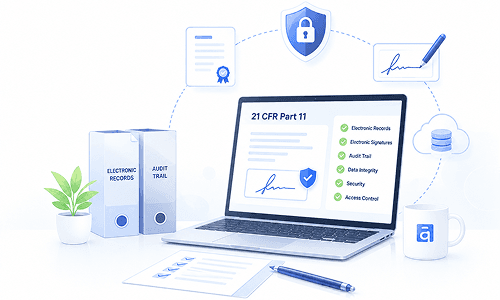
What Is 21 CFR Part 11?
21 CFR Part 11 is the FDA regulation that defines the criteria under which electronic records and electronic signatures are considered trustworthy, reliable, and equivalent to paper records and handwritten signatures. Issued by the FDA in 1997, it applies to any organization in FDA-regulated industries that creates, modifies, maintains, archives, retrieves, or transmits records electronically.
In plain terms: if your company still relies on paper printouts, wet-ink signatures, or manual sign-off sheets "just to be safe" during an FDA inspection, Part 11 is the regulation that tells you that's no longer necessary — provided your electronic systems meet its requirements.
Who Does 21 CFR Part 11 Apply To?
Part 11 applies to any FDA-regulated organization using electronic systems for records the FDA requires you to keep. This includes:
- Pharmaceutical and biopharmaceutical manufacturers
- Biotechnology companies
- Contract research organizations (CROs) and contract manufacturing organizations (CMOs)
- Medical device manufacturers
- Clinical research sites and sponsors
- Food and dietary supplement manufacturers (where FDA recordkeeping rules apply)
It covers systems across the product lifecycle — QMS platforms, LIMS, ERP, document management systems, electronic batch records, training management systems, and any tool used to generate or store GxP records.
Key Requirements of 21 CFR Part 11
Part 11 breaks down into two main pillars: electronic records and electronic signatures.
Electronic Records Requirements
- Validation — Systems generating electronic records must be validated to ensure accuracy, reliability, and consistent intended performance.
- Audit trails — Systems must maintain secure, computer-generated, time-stamped audit trails that record who did what, when, and why — without obscuring the original entry.
- Record retention & retrieval — Records must remain accurate, readable, and retrievable throughout the required retention period.
- Access controls — Only authorized individuals should be able to access, alter, or use the system and records.
- Copies for inspection — The system must be able to generate accurate, complete copies of records in both human-readable and electronic form for FDA review.
Electronic Signature Requirements
- Unique identity — Each electronic signature must be linked to one, and only one, individual — no shared logins or generic accounts.
- Signature manifestations — The signed record must display the signer's name, date/time of signing, and the meaning of the signature (e.g., approved, reviewed, authored).
- Signing components — Signatures must use at least two distinct identification components (e.g., a user ID and password), except in limited continuous-session scenarios.
- Non-repudiation — Signers must not be able to readily deny having signed a record; the binding between signature and record must be secure.
Supporting Controls
- Standard Operating Procedures (SOPs) governing system use and administration
- Personnel training and documented competency for system users
- Change control procedures for any system modifications
What Happens If You're Not Compliant?
Non-compliance with 21 CFR Part 11 doesn't carry a standalone fine, instead, it surfaces as a 483 observation or Warning Letter during an FDA inspection when audit trails are missing, records are found to be alterable without traceability, or electronic signatures can't be tied to a unique individual. Repeated or unresolved findings can escalate to consent decrees, import bans, or delayed product approvals, all of which are significantly more costly than fixing the underlying system.
Common Part 11 findings FDA investigators cite:
- Audit trails not enabled or not reviewed
- Shared user credentials across a team
- No validation documentation for the electronic system in use
- Inability to reproduce accurate electronic copies of records on request
How Zentixs Helps You Stay Part 11 Compliant
Zentixs software solutions are built with Part 11 requirements as a baseline, not an add-on:
- Validated by design — deployment-ready with validation documentation to support your qualification (IQ/OQ/PQ) process
- Immutable audit trails — every action is time-stamped and attributed to a unique user, with no ability to overwrite history
- Role-based access controls — granular permissions so only authorized users can create, approve, or modify records
- Compliant e-signatures — unique-user binding, signature meaning capture, and full signature manifestation on every signed record
- Inspection-ready exports — generate complete, human-readable and electronic copies of any record on demand
ALCOA+ Explained: Data Integrity Principles for Life Sciences
What Is ALCOA+?
ALCOA+ is the framework regulators use to judge whether GxP data can be trusted. The original ALCOA acronym, Attributable, Legible, Contemporaneous, Original, and Accurate, was introduced by the FDA in the early 1990s. The FDA's 2018 guidance, Data Integrity and Compliance With Drug CGMP Questions and Answers, formalized the extended "+" attributes, Complete, Consistent, Enduring, and Available, giving nine principles in total. It is not a standalone regulation with its own penalty clause. It is the lens FDA and other regulators use to assess compliance under existing rules like 21 CFR Parts 11, 210, and 211.
Who Does ALCOA+ Apply To?
Any organization generating or handling GxP data: pharmaceutical and biotech manufacturers, CROs and CMOs, clinical trial sponsors and sites, and medical device makers. It applies regardless of whether records are paper, electronic, or a mix of both, and regardless of where the facility is located, since FDA inspects foreign facilities supplying the US market on the same standard.
The 9 ALCOA+ Principles
Core ALCOA
- Attributable: every entry is traceable to the specific person (or system) that created it, with no shared logins
- Legible: records are readable and understandable for the full retention period
- Contemporaneous: data is recorded at the time the activity happens, not reconstructed later
- Original: the first recording of data, or a verified true copy, not a summary or transcription
- Accurate: data reflects what actually happened, free of errors, with corrections documented rather than overwritten
The "+" attributes
- Complete: all data, including repeat or reanalysis results, is retained, not just the favorable run
- Consistent: data is recorded in the expected sequence, with consistent timestamps and formatting across the record
- Enduring: records remain intact and unaltered for the full required retention period
- Available: records can be accessed and retrieved on request, including during inspections, for as long as required
2026 Update: Where Regulatory Alignment Stands
Data integrity expectations are converging across regions rather than changing at their core:
- ICH E6(R3), the revised Good Clinical Practice guideline, was finalized in January 2025 and embeds ALCOA-aligned data governance requirements directly into clinical trial conduct. It is already applicable in the EU (since July 2025) and under FDA final guidance (issued September 2025), with Canada's effective date following in April 2026
- EU GMP Chapter 4 has a draft revision (circulated mid-2025) that would formally codify an expanded set of attributes, often referred to as ALCOA++, directly into EU GMP rather than leaving it as guidance
- PIC/S continues to align its own data integrity guidance with ALCOA+ language, which matters for any Indian facility inspected under PIC/S-aligned national authorities
The practical effect for life sciences companies: multiple naming conventions (ALCOA+, ALCOA++, ALCOA-CCEA) are circulating across regulators right now, which can mean maintaining documentation that satisfies more than one inspector's preferred framework. The underlying nine ALCOA+ principles remain the common denominator across all of them.
What Happens When ALCOA+ Principles Are Violated?
ALCOA+ failures do not carry a separate fine. They surface as data integrity findings within an FDA 483 observation or Warning Letter, most often tied to CGMP violations under 21 CFR Parts 210, 211, or Part 11. Common findings include:
- Shared user credentials, breaking attributability
- Backdated or reconstructed records, breaking contemporaneous recording
- Selective reporting of only passing test results, breaking completeness
- Audit trails that are disabled, not reviewed, or can be altered without trace
Repeated or unresolved data integrity findings escalate faster than most other citation types and have led to import alerts and consent decrees, since they call into question the reliability of everything else in a company's quality system.
How Zentixs Supports ALCOA+ Compliance
- Unique-user attribution on every record, with no shared login paths
- Time-stamped, immutable audit trails that capture the full history of an entry, including corrections
- Real-time data capture workflows designed to keep entries contemporaneous by default
- Complete record retention, including repeat tests and reanalysis, not just final approved results
- Validated retrieval so records stay available and enduring across the full retention period
DPDP Act Explained: India's Digital Personal Data Protection Law Guide 2026 Update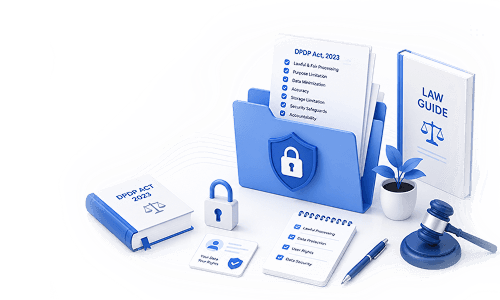
What Is the DPDP Act?
The Digital Personal Data Protection Act, 2023 (DPDP Act) is India's primary law governing how organizations collect, process, store, and use the digital personal data of individuals in India. It received Presidential assent on August 11, 2023, and was published in the Gazette of India the same day.
For over two years after assent, the Act existed without an operational framework. That changed on November 13, 2025, when the Ministry of Electronics and Information Technology (MeitY) notified the Digital Personal Data Protection Rules, 2025 (DPDP Rules), which set out the practical mechanics of compliance, including consent flows, breach notification, and the constitution of the Data Protection Board of India (DPBI). With the Rules in place, the DPDP Act is now a live, enforceable framework, not a future concern.
Who Does the DPDP Act Apply To?
The DPDP Act applies to any organization, inside or outside India, that processes the digital personal data of individuals located in India. This includes:
- Indian companies handling customer, employee, or patient data digitally
- Foreign companies (including US and EU-based CROs, SaaS vendors, and pharma sponsors) that offer goods or services to individuals in India
- Data Processors acting on behalf of a Data Fiduciary (the entity that determines the purpose and means of processing)
It applies specifically to personal data collected in digital form, or collected offline and later digitized. Purely offline, non-digitized personal data falls outside its scope.
2026 Update: Where Implementation Stands
The DPDP Act and Rules are being rolled out in phases rather than all at once. As of mid-2026, the timeline looks like this:
- November 13/14, 2025: DPDP Rules notified; the Data Protection Board of India established; the Act formally comes into force
- November 2026: First major compliance milestone, roughly 12 months after notification. Organizations are expected to have redesigned consent notices and consent flows, published grievance redressal mechanisms, and registered Consent Managers where applicable. Government reporting also suggests this window may see the rollout of an interoperable Consent Manager framework, letting individuals manage consent across multiple platforms from one place
- May 13, 2027: Full enforcement date, roughly 18 months after notification, when the remaining substantive obligations and the Data Protection Board's penalty powers take effect
Some provisions, including cross-border data transfer restrictions and formal Significant Data Fiduciary (SDF) designations, are still pending separate government notification. Organizations should treat the current window as a preparation period, not a waiting period. Enforcement readiness needs to be built now, since the compliance runway shortens fast once the Board moves from guidance to active supervision.
Key Obligations Under the DPDP Act
For Data Fiduciaries (organizations that decide why and how data is processed)
- Obtain clear, specific, and informed consent before processing personal data, with an easy option to withdraw it
- Limit data collection and use to the stated purpose (purpose limitation and data minimization)
- Provide a notice, in clear language, explaining what data is collected and why
- Implement reasonable security safeguards to prevent data breaches
- Report personal data breaches to the Data Protection Board and affected individuals
- Erase personal data once its purpose is fulfilled, unless retention is legally required
- Appoint a Data Protection Officer and grievance redressal contact, where applicable
For Significant Data Fiduciaries (organizations processing data at large scale)
- Conduct periodic Data Protection Impact Assessments
- Undergo independent data audits
- Appoint an India-based Data Protection Officer
- Comply with additional data localization and cross-border transfer conditions once notified
Rights of Data Principals (individuals whose data is processed)
- Right to access information about how their data is processed
- Right to correction and updating of their data
- Right to erasure of their data
- Right to grievance redressal
- Right to nominate another individual to exercise these rights on their behalf in case of death or incapacity
Penalties for Non-Compliance
The DPDP Act gives the Data Protection Board of India the power to impose financial penalties for non-compliance, with amounts reaching up to INR 250 crore (roughly USD 30 million) for the most serious violations, such as failing to implement reasonable security safeguards or failing to report a data breach. Penalty amounts scale with the nature and severity of the violation rather than applying a flat figure across the board.
How the DPDP Act Differs From GDPR
The DPDP Act shares GDPR's consent-centric philosophy but is structurally simpler. It does not include GDPR's detailed lawful-basis categories (legitimate interest, contract, and so on) beyond a narrower list of "legitimate uses," and its penalty structure is a single unified scale rather than GDPR's tiered percentage-of-turnover model. Organizations already GDPR-compliant have a head start, but should not assume GDPR compliance automatically satisfies DPDP requirements. A separate gap assessment is needed.
How Zentixs Helps You Stay DPDP Compliant
Zentixs products are built with DPDP obligations translated directly into product-level controls:
- Consent and notice management built into data capture workflows across Zentixs modules
- Role-based access controls so personal data is only visible to authorized users
- Audit trails that support breach investigation and Data Protection Board reporting requirements
- Data retention and deletion controls aligned to purpose limitation requirements
- Documentation support for Data Protection Impact Assessments and vendor due diligence
GDPR Explained: EU Data Protection Compliance Guide 2026 Update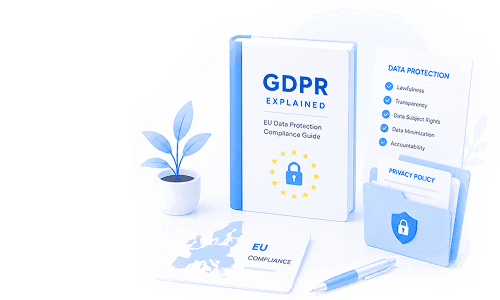
What Is GDPR?
The General Data Protection Regulation (GDPR) is the European Union's data protection law, in force since May 25, 2018. It sets the global benchmark for how organizations must collect, process, store, and protect the personal data of individuals in the EU, and it remains the reference point most other data protection laws, including India's DPDP Act, are compared against.
Does GDPR Apply to Indian Companies?
Yes, and this is the point most Indian companies get wrong. GDPR has extraterritorial reach under Article 3. It applies to any organization, regardless of where it is based, if it:
- Has an establishment in the EU, or
- Offers goods or services to individuals in the EU (even for free), or
- Monitors the behavior of individuals in the EU (analytics, tracking, profiling)
So a life sciences company based in Ahmedabad running clinical trials for an EU sponsor, storing EU patient or investigator data, or simply operating a website that markets to EU customers, can fall within GDPR's scope even without an EU office. This applies alongside domestic law. Serving EU clients does not exempt an Indian company from the DPDP Act, and vice versa. Both can apply to the same dataset at once.
Key Requirements of GDPR
Core Principles
- Lawfulness, fairness, transparency: processing needs a valid legal basis and must be clearly explained to individuals
- Purpose limitation: data collected for one purpose cannot be reused for an unrelated one without new grounds
- Data minimization: collect only what is necessary
- Accuracy: keep data correct and up to date
- Storage limitation: do not keep data longer than needed
- Integrity and confidentiality: appropriate security safeguards
- Accountability: organizations must be able to demonstrate compliance, not just claim it
Lawful Bases for Processing
Every use of personal data needs one of six lawful bases: consent, contract necessity, legal obligation, vital interests, public task, or legitimate interests. Consent is the most commonly cited but not always the right fit. For most B2B contractual data processing, "contract necessity" or "legitimate interests" is often the more defensible basis.
Individual Rights
- Right to access their data
- Right to rectification (correction)
- Right to erasure ("right to be forgotten")
- Right to restrict processing
- Right to data portability
- Right to object to processing, including profiling
- Rights related to automated decision-making
Organizational Obligations
- Appoint a Data Protection Officer (DPO) where required, such as for large-scale monitoring or sensitive data processing
- Maintain a Record of Processing Activities (RoPA)
- Conduct Data Protection Impact Assessments (DPIAs) for high-risk processing
- Report qualifying data breaches to the relevant supervisory authority within 72 hours
- Use approved mechanisms, such as Standard Contractual Clauses, for transfers of personal data outside the EU
2026 Update: The Digital Omnibus Reform
GDPR's core principles are not changing. What is changing is a simplification package, the EU's Digital Omnibus, published by the European Commission on November 19, 2025. It actually splits into two tracks moving at different speeds. The AI-related track reached a provisional agreement in May 2026 and is largely settled. The GDPR and data-protection track is the contested one: it remains under negotiation as of mid-2026, and reporting indicates the Council's own working text has already dropped some of the proposed cookie-consent provisions. Nothing here is confirmed law. Key proposals still on the table:
- Narrower "personal data" scope: information may not count as personal data for an organization that has no reasonable means to identify the individual from it
- Pseudonymized and anonymized data: clearer rules on when this can be shared with third parties without triggering GDPR obligations
- RoPA exemption raised: the recordkeeping exemption may expand from organizations under 250 employees to those under 750 employees, with the qualifying risk threshold narrowed to "high risk" processing
- Cookie consent reform: proposed single-click "accept all or reject all" banners, with a required six-month gap before a user can be asked again after refusing, though this specific piece faces the most resistance
Maximum fines are not proposed to change. Treat all of this as a direction of travel, not a current obligation, and expect the GDPR-specific pieces to take longer to settle than the AI-related ones.
Penalties for Non-Compliance
GDPR fines are tiered based on the type of violation:
- Lower tier: up to EUR 10 million or 2% of global annual turnover, whichever is higher (for breaches such as inadequate records or failure to notify a breach)
- Upper tier: up to EUR 20 million or 4% of global annual turnover, whichever is higher (for breaches of core principles, lawful basis, or individual rights)
Turnover is calculated globally, not just EU revenue, which is why GDPR exposure matters even for companies with a small EU footprint.
GDPR vs. DPDP Act: Quick Comparison
| Feature | GDPR | DPDP Act |
|---|---|---|
| Jurisdiction | EU, plus extraterritorial reach | India, plus extraterritorial reach |
| Lawful bases | Six distinct bases | Consent plus a narrower list of "legitimate uses" |
| Penalty structure | Tiered, percentage of global turnover | Fixed scale, up to INR 250 crore |
| DPO requirement | Required for certain high-risk processing | Required for Significant Data Fiduciaries only |
| Status | Fully in force since 2018, reform proposed | Rules notified 2025, phased enforcement through 2027 |
Being GDPR compliant is a strong foundation for DPDP compliance, and vice versa, but the two are not identical. A gap assessment against each is the only way to confirm full coverage.
How Zentixs Helps You Stay GDPR Compliant
- Consent and lawful basis tracking built into data capture workflows
- Role-based access controls limiting who can view or export personal data
- Audit trails supporting breach investigation and 72-hour notification timelines
- Data retention and deletion controls aligned to storage limitation requirements
- Documentation support for RoPA and DPIA preparation across Zentixs modules
GxP Compliance Explained: GMP, GLP, GCP Guide 2026 Update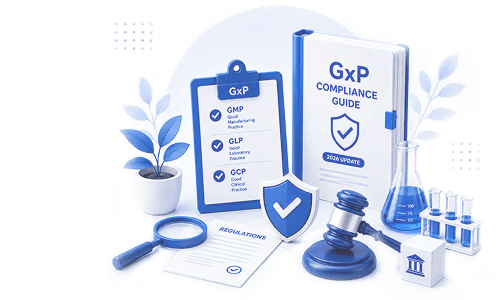
What Is GxP?
GxP stands for "Good x Practice," where x is replaced by the specific practice area. It is the umbrella term for the quality guidelines that govern regulated life sciences activities, built on a shared foundation: documented processes, data integrity, traceability, and independent quality oversight. GxP is not one regulation. It is a family of related standards, and the one that applies depends on what the organization actually does.
The Three Core GxP Domains
GMP (Good Manufacturing Practice)
Governs how pharmaceutical and medical device products are manufactured, tested, and released. Covers facility controls, equipment qualification, batch records, and change control. In the US, GMP requirements sit in 21 CFR Parts 210 and 211 for drugs, and Part 820 (now aligned with ISO 13485:2016, see 2026 update below) for medical devices.
GLP (Good Laboratory Practice)
Governs how non-clinical laboratory studies, most commonly toxicology and safety studies conducted before human trials begin, are planned, performed, monitored, recorded, and reported. The goal is to ensure that data submitted to regulators is reliable and reproducible. GLP is distinct from GCP: a toxicology study on animals falls under GLP, while a trial involving human subjects falls under GCP.
GCP (Good Clinical Practice)
Governs the design, conduct, recording, and reporting of clinical trials involving human subjects. It protects trial participants' rights, safety, and wellbeing while ensuring the resulting data is credible. GCP is defined internationally through the ICH E6 guideline, most recently revised as ICH E6(R3).
Related domains you'll also see referenced, particularly around supply chain and regulatory governance, include GDP (Good Distribution Practice) and GRP (Good Regulatory Practice), though GMP, GLP, and GCP remain the three most commonly cited in day-to-day compliance work.
Who Does GxP Apply To?
Any organization that manufactures pharmaceutical products, conducts regulated non-clinical laboratory studies, runs clinical trials, or manufactures medical devices. This includes pharmaceutical and biotech manufacturers, CROs and CMOs, clinical trial sponsors and sites, and medical device makers, regardless of where the facility is located, since regulators inspect foreign facilities supplying their market on the same standard.
What GxP Compliance Actually Requires
Across all three domains, regulators are checking for the same underlying elements:
- Documented processes and SOPs governing every regulated activity
- Data integrity, most often assessed against the ALCOA+ principles
- Independent quality oversight, separate from the people performing the work: Quality Control and Quality Assurance in GMP, a Quality Assurance Unit in GLP, and sponsor quality oversight plus IRB/IEC review in GCP
- Training and documented competency calibrated to each role, not generic across the organization
- Defined record retention periods, which vary by domain: GMP batch records are typically kept until one year after product expiry, GLP raw data and reports per the applicable regulation, and GCP trial documents for at least two years after regulatory approval or trial discontinuation
- Audit trails and CAPA systems that connect across domains rather than operating in silos, since regulators increasingly assess governance patterns, not just isolated findings
2026 Update: What's Changed
- ICH E6(R3), the revised GCP guideline, became effective July 23, 2025, and embeds stronger data governance requirements directly into clinical trial conduct
- FDA's Quality Management System Regulation (QMSR) took effect February 2, 2026, replacing the standalone 21 CFR Part 820 framework for medical devices with one aligned to the international standard ISO 13485:2016. Any organization manufacturing devices or combination products now needs a quality system built to that standard
- EU GMP revisions are in progress: a revised Chapter 1 on the Pharmaceutical Quality System is expected by the end of 2026, alongside a proposed revision of Annex 15 on Qualification and Validation. Neither is finalized yet
- Data integrity findings remain the most cited category in FDA Warning Letters across GMP, GLP, and GCP in 2025 and 2026, which is why ALCOA+ alignment matters as much as domain-specific compliance
Consequences of GxP Non-Compliance
GxP findings surface as FDA 483 observations or Warning Letters, or their equivalents from EMA and other regulators. Common patterns across domains include gaps in documentation, unreviewed or disabled audit trails, inadequate CAPA follow-through, and siloed systems that let the same underlying issue recur across GMP, GLP, and GCP without being caught. Unresolved findings can escalate to import alerts, consent decrees, or delayed approvals.
How Zentixs Supports GxP Compliance
- Cross-domain visibility, so deviations and CAPAs in one area are traceable against activity in others, rather than sitting in disconnected systems
- Role-calibrated training records matched to GMP, GLP, or GCP responsibilities
- ALCOA+-aligned audit trails across every regulated record, electronic from creation
- Configurable retention rules matched to each domain's required retention period
- Validated document control supporting SOP management, change control, and inspection readiness