

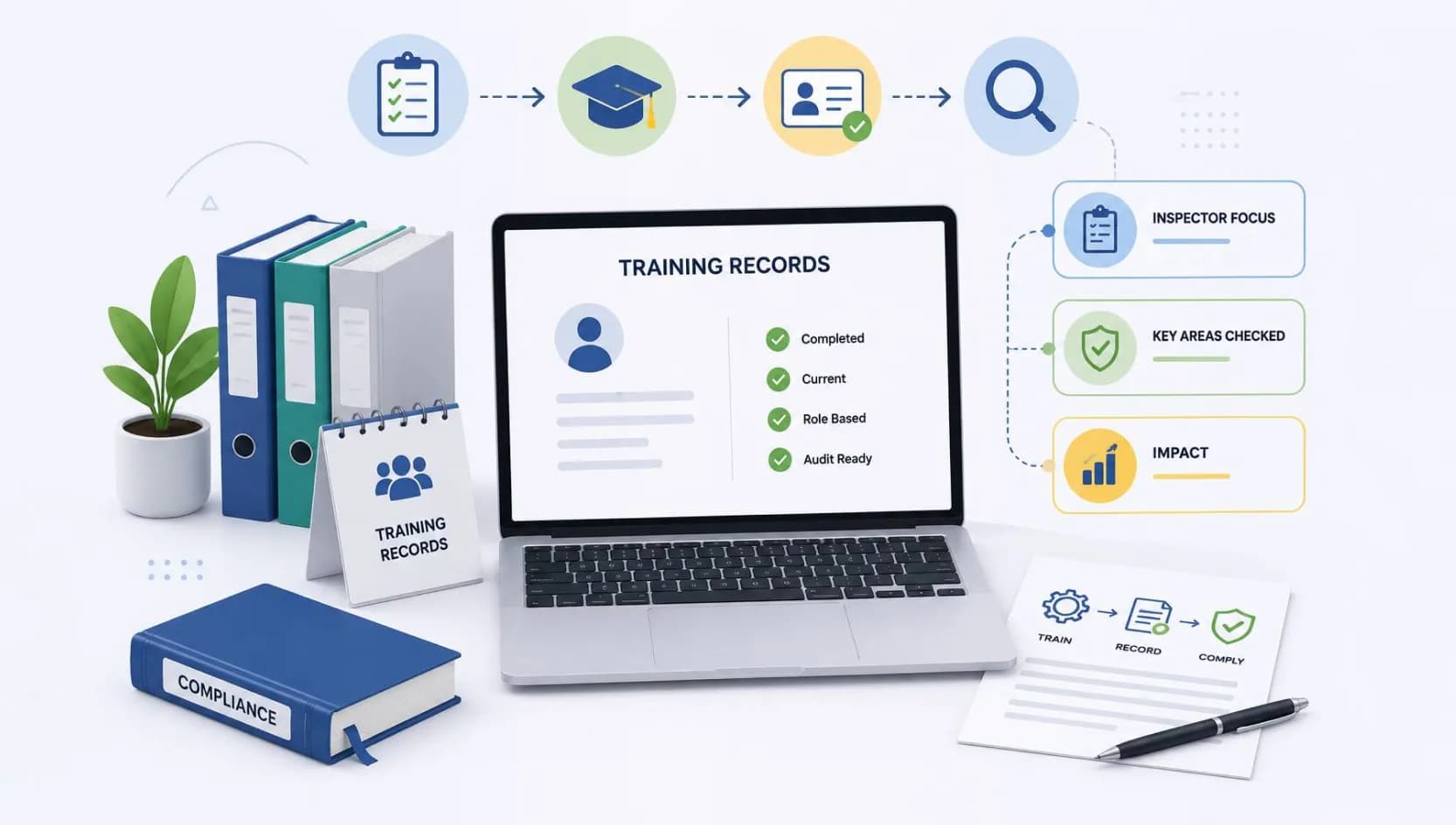
When an FDA investigator arrives for an inspection, one of the first questions they often seek to answer is surprisingly simple: Can this organization prove that its employees are qualified to perform the work they are doing?
The answer lies in training records. Training documentation is not merely an HR requirement. In regulated life sciences environments, it is a critical component of GMP compliance, product quality, safety, and inspection readiness. FDA regulations require organizations to ensure that personnel possess the education, training, and experience necessary to perform their assigned responsibilities. More importantly, companies must be able to demonstrate this through complete, accurate, and readily retrievable records.
Many organizations assume that a signed attendance sheet is enough to satisfy inspectors. In reality, FDA investigators review training records in much greater detail. They look for evidence that training was completed, understood, maintained, and linked directly to the employee's responsibilities.
Individual Employee Training Records
FDA investigators frequently request employee training files to verify personnel qualifications before regulated activities are performed.
-
 GMP Training
 - Role-Based Training
- Safety Training
- Data Integrity Training
- Retraining Records
SOP Training Records
Inspectors verify that employees were trained on current SOP versions before performing activities governed by those procedures.
- Current SOP Versions
- Revision Training
- Retraining Timelines
- Training Completion
- Version Traceability
Training Matrix & Role Requirements
Training matrices provide a centralized view of training assignments and completion status across all departments.
- Role Mapping
- Required Courses
- Qualification Gaps
- Department Oversight
- Inspection Visibility
Qualification and Competency Records
Completing a training session does not automatically demonstrate competence. FDA expectations extend beyond attendance. Investigators increasingly review evidence that employees can perform assigned tasks correctly and consistently.
A signed training record may demonstrate participation. This proves that an employee attended a session, but it doesn't establish capability.
A competency assessment demonstrates effectiveness. This may include practical evaluations, qualification exercises, competency assessments, proficiency checks, or documented observations by qualified supervisors. The objective is straightforward: Regulators want assurance that employees understand the procedures they follow and can execute them correctly in real world situations.
Refresher Training Records
Training is not a one time event. Under 21 CFR 211.25, GMP training must be conducted on a continuing basis and with sufficient frequency to ensure personnel remain familiar with applicable requirements. FDA investigators therefore review records for periodic retraining and refresher programs. Organizations often focus heavily on onboarding but overlook ongoing training requirements. This becomes a significant risk during inspections because outdated training records can indicate a lack of oversight within the quality system. Regular refresher training helps reinforce procedures, regulatory expectations, data integrity principles, and lessons learned from deviations and CAPAs.
Trainer Qualification Records
Inspectors may also evaluate the qualifications of the individuals providing training. FDA regulations specify that GMP training should be conducted by qualified personnel. Organizations should therefore maintain records demonstrating the trainer's expertise, experience, and authority to deliver instruction. Without evidence that trainers themselves are qualified, the effectiveness and credibility of the training program may be questioned.
Training Records Linked to Deviations and CAPAs
Training documentation should never exist in isolation. Effective quality systems connect training records with deviations, CAPAs, change controls, and quality events to create a complete compliance picture. This connection becomes particularly important when an inspection focuses on a deviation, complaint, out of specification result, or corrective action:
- In these situations, investigators often review the training history of the employees involved in the event.
- Their goal is to determine whether inadequate training contributed to the event and whether corrective actions effectively addressed the root cause.
- Many life sciences organizations are moving toward integrated digital quality ecosystems that make these relationships easier to manage, review, and retrieve during inspections.
Common Training Deficiencies Observed by FDA
Recent FDA warning letters continue to highlight recurring issues related to personnel qualification and training programs. These observations demonstrate that training remains one of the most scrutinized areas during inspections and one of the most frequent sources of compliance gaps.
Common findings include incomplete training records and undocumented retraining activities.
Lack of training effectiveness assessments across core operational milestones.
Missing qualification records and inadequate oversight of employee competency programs.
Inspection Readiness Starts with Training Readiness
Training records are often viewed as administrative documents until an FDA inspection begins. At that point, they become evidence of whether an organization has maintained control over its people, processes, and quality systems.
The most inspection ready organizations are those that can immediately demonstrate who was trained, what they were trained on, when the training occurred, which version of the procedure was involved, and whether competency was verified. As regulatory expectations continue to evolve, manual training management becomes increasingly difficult to sustain. Centralized digital quality platforms can help organizations maintain training traceability, automate retraining workflows, link training to SOPs and quality events, and ensure records are inspection ready at all times.
Solutions such as the Zentixs Suite support this connected approach by helping life sciences organizations maintain control over critical quality records while ensuring rapid retrieval during audits and regulatory inspections.
Because when FDA investigators ask for training records, the real question is not whether training occurred. The question is whether your quality system can prove it.
Ready to Streamline Training Compliance?
Contact the Adrta team today to learn how the Zentixs Platform provides complete oversight and instant traceability for all your personnel qualification needs.