

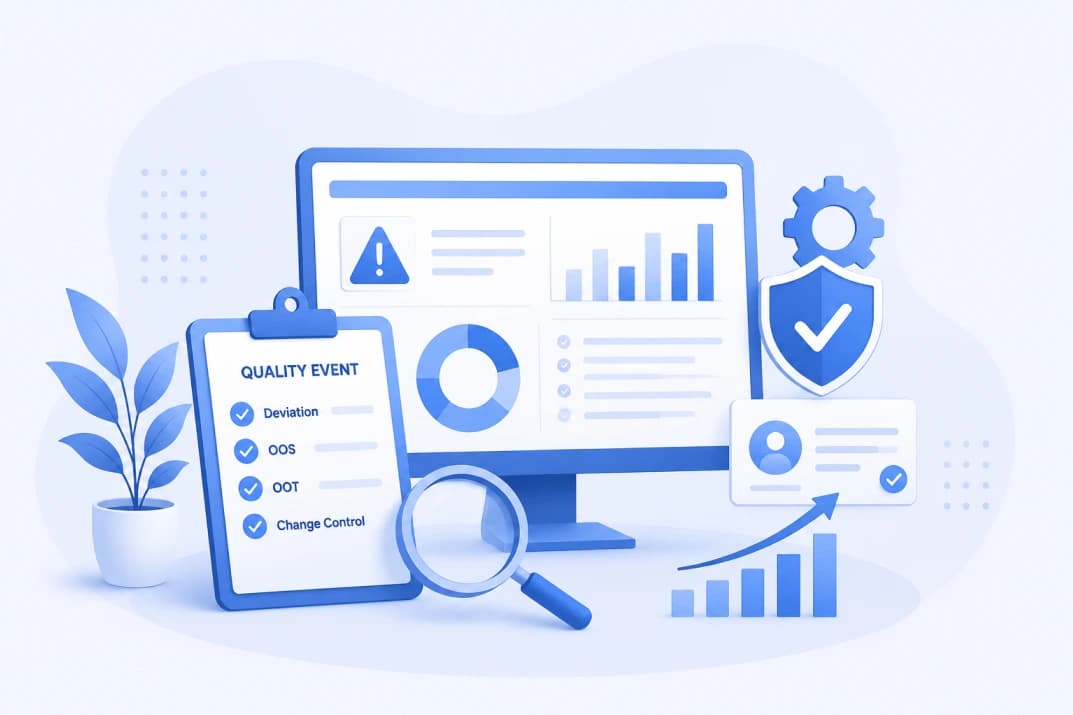
In life sciences organizations, quality events are inevitable. Deviations occur during manufacturing. Out of Specification (OOS) results emerge during laboratory testing. Out of Trend (OOT) findings raise concerns about process consistency, and operational improvements often require controlled changes. What differentiates high performing organizations from those that struggle during inspections is not the absence of quality events but how effectively they manage them.
Regulatory agencies including the FDA continue to emphasize the importance of thorough investigations, timely resolution of quality events, effective corrective actions, and documented oversight. As manufacturing processes become more complex and regulatory scrutiny increases, manual methods for managing deviations, OOS investigations, OOT assessments, and change controls are becoming increasingly difficult to sustain.
Organizations that continue to rely on paper records, spreadsheets, email chains, and disconnected systems often face challenges related to visibility, traceability, accountability, and inspection readiness. This is why many life sciences companies are accelerating their transition toward digital quality management systems that provide centralized control over quality events throughout their lifecycle.
Understanding the Relationship Between Quality Events
Although deviations, OOS investigations, OOT assessments, and change controls are often managed separately, they are closely connected within an effective pharmaceutical quality system.
In many cases, one quality event can trigger another. A deviation investigation may identify the need for a change control. An OOS investigation may reveal a process issue that results in corrective actions and procedural updates. OOT trends may uncover underlying process variability that requires further assessment. Because of these interdependencies, organizations need a structured approach that allows information to flow seamlessly across quality processes.
Quality Events Categorization Matrix
| Event Type | Core Technical Definition |
|---|---|
| Deviation | Occurs when an activity departs from an approved procedure, specification, process, or expected outcome. |
| OOS | Out of Specification results refer to test results that fall outside established acceptance criteria or specifications. |
| OOT | Out of Trend results may remain within specification limits but indicate an unexpected variation from historical trends that requires evaluation. |
| Change Control | Used to assess and manage modifications that could impact product quality, patient safety, validated processes, or regulatory compliance. |
The Challenges of Manual Quality Event Management
Many life sciences companies still manage quality events using a combination of paper records, spreadsheets, shared folders, and email communications. While these approaches may appear manageable initially, they often become difficult to maintain as organizations grow.
Investigations can become delayed because information is scattered across multiple systems. Approvals may be missed or overlooked. Action items may remain open longer than expected. Trending and reporting activities can become time consuming and resource intensive. Perhaps most importantly, manual systems often make it difficult to demonstrate complete oversight during regulatory inspections.
FDA investigators frequently examine whether organizations conduct timely investigations, identify root causes effectively, implement appropriate corrective actions, and verify effectiveness after implementation. When documentation is fragmented or difficult to retrieve, organizations may struggle to demonstrate compliance even when work has been performed correctly.
Managing Deviations with Greater Visibility
Deviation management remains one of the most heavily scrutinized areas during inspections because deviations often provide insight into the overall health of a quality system.
A well managed deviation process should include event identification, impact assessment, investigation, root cause analysis, corrective and preventive actions, effectiveness verification, and final approval.
When managed manually, deviation records can be difficult to track. Multiple stakeholders may be involved in investigations, making communication and accountability challenging. Escalations can be delayed and overdue investigations may go unnoticed. Digital quality management platforms help address these challenges by centralizing deviation workflows, assigning responsibilities automatically, tracking due dates, and providing real time visibility into investigation status. This level of oversight helps quality teams focus on resolving issues rather than managing administrative tasks.
Strengthening OOS Investigations
FDA expectations for OOS investigations remain firmly rooted in scientific justification, thorough documentation, and objective evaluation.
Organizations are expected to investigate laboratory and manufacturing causes before invalidating results or retesting samples.
An effective OOS process requires detailed documentation of laboratory investigations, manufacturing assessments, root cause determinations, and final conclusions. Every decision must be supported by evidence and maintained in a manner that can withstand regulatory scrutiny. Manual systems often create challenges because critical information may be stored in separate locations or communicated through email exchanges that are difficult to reconstruct later. Digital workflows provide a structured framework for documenting investigations consistently while ensuring that required review and approval steps are completed before closure. This not only improves compliance but also strengthens the overall quality of investigations.
Why OOT Management Is Becoming Increasingly Important
While OOS results receive significant regulatory attention, OOT findings are equally important because they can serve as early indicators of emerging process issues.
An OOT result may not violate specifications, but it can reveal trends that suggest declining process performance, equipment issues, analytical variability, or manufacturing inconsistencies.
Organizations that fail to monitor and investigate OOT trends risk missing opportunities to identify problems before they escalate into deviations, complaints, batch failures, or regulatory findings. Digital quality systems enable organizations to capture and trend data more effectively, making it easier to identify recurring patterns and investigate potential risks proactively. Rather than reacting to quality failures after they occur, organizations gain the ability to detect signals earlier and respond more effectively.
Improving Change Control Effectiveness
Change control is a fundamental requirement within regulated environments because even seemingly minor modifications can affect product quality, safety, efficacy, or compliance.
Changes involving equipment, facilities, manufacturing processes, analytical methods, specifications, software systems, suppliers, and documentation must be evaluated carefully before implementation.
One of the most common challenges with manual change control systems is ensuring that all affected areas are considered during impact assessments. Organizations may overlook training requirements, validation activities, regulatory filings, document updates, or risk assessments. Digital workflows help standardize change evaluation processes by ensuring required assessments are completed consistently before approvals are granted. Many organizations are also integrating change control activities with related quality processes so that document updates, training assignments, validation tasks, and approvals are automatically linked to the change being implemented.
The Importance of Audit Trails and Data Integrity
Data integrity continues to be a major focus for regulators worldwide. FDA guidance emphasizes the need for records that are attributable, legible, contemporaneously recorded, original, accurate, complete, consistent, enduring, and available throughout their lifecycle.
When quality events are managed through paper files and spreadsheets, maintaining complete traceability can become difficult. Organizations may struggle to demonstrate who performed specific actions, when activities occurred, or whether records were modified after approval.
Digital quality management systems automatically capture audit trails that document user actions, approvals, revisions, comments, timestamps, and workflow progression. These capabilities strengthen transparency while helping organizations meet regulatory expectations for record integrity and traceability.
Building a Connected Quality Ecosystem
One of the biggest advantages of digital quality management is the ability to connect previously isolated processes.
A deviation may trigger a CAPA. A CAPA may require a document revision. A document revision may generate training requirements. A change control may initiate validation activities. Managing these relationships manually can be time consuming and prone to error.
A connected quality ecosystem allows information to move seamlessly across processes while maintaining full visibility and traceability.
As regulatory expectations continue to evolve, organizations are increasingly seeking platforms that bring quality management, document control, training management, electronic approvals, and records retention together within a single compliance framework.
Why Pharma & Biotech Teams Standardize on Zentixs Track
Cross-Linked Workflows
Instantly trigger CAPAs or document changes from deviations or OOS records, tracking dependencies in a single tree view.
Pre-Validated ALCOA+ Logs
Enforce unalterable, system-generated audit trails with accurate user timestamps that perfectly answer FDA requirements.
Proactive Analytics
Surface OOT parameters and trend recurring abnormalities early to reduce open cycle bottlenecks before audit phases.
Preparing for the Future of Quality Management
Managing deviations, OOS investigations, OOT assessments, and change controls effectively requires more than compliance. It requires visibility, collaboration, accountability, and data driven decision making.
Organizations that continue to rely on fragmented manual systems often face increasing operational burdens as regulatory requirements and business complexity grow. In contrast, organizations that embrace digital quality management gain stronger oversight, faster investigations, improved reporting capabilities, and enhanced inspection readiness.
The future of quality management lies in connected systems that enable proactive quality oversight rather than reactive issue management. As life sciences companies continue their digital transformation journeys, solutions such as Zentixs Track and the broader Zentixs Suite from **Adrta Technologies** help organizations streamline quality processes, improve compliance visibility, and maintain control over critical quality events throughout their entire lifecycle.
Unify Your Quality Events Ecosystem Today
Connect your deviations, laboratory OOS investigations, trend logs, and cross-department change controls using the cloud-native workflows of Zentixs Track.
Schedule a System Overview