

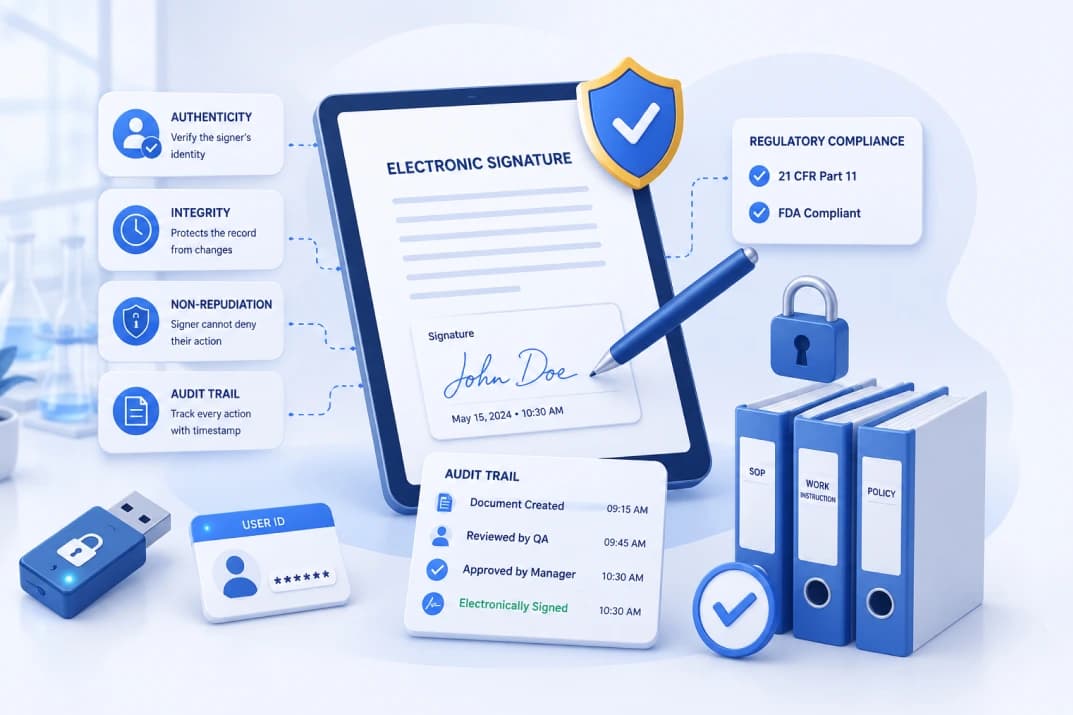
Electronic signatures have become an essential part of modern quality and compliance processes within the life sciences industry. From document approvals and training acknowledgments to batch record reviews and quality event investigations, organizations are increasingly replacing paper-based signatures with secure digital alternatives.
The benefits are clear. Electronic signatures accelerate approval cycles, improve visibility, reduce administrative burden, and support digital transformation initiatives. However, in regulated environments, implementing an electronic signature solution is only part of the requirement. Organizations must also ensure that electronic signatures are properly validated and capable of meeting regulatory expectations.
Regulatory agencies including the FDA recognize the use of electronic records and electronic signatures, but they also require organizations to demonstrate that these systems are trustworthy, reliable, and equivalent to paper records and handwritten signatures. Failure to validate electronic signature systems adequately can create compliance risks that become apparent during audits and inspections.
Understanding how to validate electronic signatures properly is essential for maintaining compliance while realizing the operational benefits of digital workflows.
Understanding the Regulatory Foundation
When discussing electronic signatures in life sciences, the primary regulatory reference remains 21 CFR Part 11. This regulation establishes the criteria under which electronic records and electronic signatures are considered trustworthy, reliable, and generally equivalent to paper records.
Part 11 requires organizations to implement controls that ensure electronic signatures are unique to an individual, cannot be readily repudiated, and are linked permanently to the associated electronic record.
In addition to FDA requirements, many organizations also align their systems with global expectations outlined in guidance documents and industry standards related to computerized systems, data integrity, and Good Manufacturing Practices.
What Validation Actually Means
One of the most common misconceptions is that software vendors validate electronic signature systems on behalf of customers.
While software providers may validate their development processes and provide supporting documentation, regulated organizations remain responsible for validating the system within their intended use environment.
Validation involves generating documented evidence that the system performs according to predefined requirements and that electronic signatures function correctly under actual operating conditions.
Auditors and inspectors expect organizations to demonstrate that validation activities were planned, executed, reviewed, approved, and maintained throughout the system lifecycle.
The goal is not simply to install software. The goal is to prove that the system supports compliant business processes consistently and reliably.
Core Signature Validation Matrix
| Validation Step | Documented Requirement Targets |
|---|---|
| User Requirements | Define security, authentication, access control, audit trails, record retention, workflows, and reporting. |
| Risk Assessment | Evaluate user authentication, signature execution, audit trail generation, and access permissions. |
| Authentication | Confirm unique accounts, password management, access restrictions, and role assignments. |
| Audit Trails | Verify secure, time-stamped, and automated tracking of critical data actions over retention periods. |
Define User Requirements Clearly
Every successful validation project begins with clearly documented user requirements.
Organizations should identify how electronic signatures will be used across quality, manufacturing, laboratory, regulatory, training, and document management processes. Requirements should address security, authentication, access control, audit trails, record retention, workflow approvals, and reporting capabilities. User requirements establish the foundation for all subsequent validation activities.
Without clearly defined requirements, it becomes difficult to demonstrate that the implemented solution meets business and regulatory expectations. A structured requirements process also helps ensure alignment between operational needs and compliance objectives before implementation begins.
Assess Risks Before Validation
Current industry expectations increasingly emphasize risk-based validation approaches.
Rather than treating all system functions equally, organizations should assess which functions have the greatest impact on product quality, patient safety, data integrity, and regulatory compliance. For electronic signature systems, critical areas typically include user authentication, signature execution, audit trail generation, access permissions, record integrity, and approval workflows.
Risk assessments help determine the level of testing necessary to provide confidence that critical functions operate correctly. This approach supports efficient validation while maintaining focus on areas that present the greatest compliance risk.
Verify User Authentication Controls
Electronic signatures are only reliable when user identities can be verified accurately.
Validation activities should confirm that each user has a unique account and that authentication controls prevent unauthorized access. Password management, account administration, access restrictions, and user role assignments should all be evaluated carefully.
Organizations should verify that users cannot share credentials, bypass authentication requirements, or access functions beyond their authorized responsibilities.
Inspectors often review these controls because weak authentication practices can undermine the credibility of electronic records and signatures. Strong identity management remains one of the most important components of a compliant electronic signature system.
Confirm Signature Integrity
A validated electronic signature must remain permanently linked to the record it approves.
Organizations should verify that signatures cannot be copied, transferred, altered, removed, or reassigned without detection. Validation testing should confirm that signature records contain the necessary information to identify the signer, date, time, and meaning of the signature action.
For example, a signature may indicate review, approval, authorization, verification, or acknowledgment depending on the workflow.
Auditors frequently examine whether signature records remain intact throughout the record lifecycle and whether the relationship between the signature and underlying record can be reconstructed easily. These controls help ensure accountability and maintain confidence in regulated records.
Validate Audit Trail Functionality
Audit trails remain a major focus during inspections and audits.
Electronic signature systems should automatically capture critical activities including record creation, modification, review, approval, and signature execution. Audit trail entries should be secure, time-stamped, and protected from unauthorized modification.
Validation testing should verify that audit trails function consistently and that historical activities can be retrieved when needed. Organizations should also confirm that audit trail information remains available throughout applicable retention periods. Strong audit trail controls support data integrity requirements and provide transparency into system activities.
Test Workflow and Approval Processes
Many organizations implement electronic signatures as part of broader workflow automation initiatives.
Document approvals, change controls, deviations, CAPAs, training acknowledgments, and quality reviews often depend on electronic approval workflows.
Validation activities should verify that workflows route records correctly, enforce approval sequences, prevent unauthorized actions, and maintain complete traceability. Testing should include both expected use scenarios and exception conditions to ensure workflows perform reliably under different circumstances. This helps prevent process failures that could affect compliance or operational efficiency.
Maintain Validation Throughout the System Lifecycle
Validation is not a one-time event completed at system implementation.
Regulatory expectations require organizations to maintain systems in a validated state throughout their lifecycle. Changes to software configurations, workflows, integrations, infrastructure, security settings, or business processes should be assessed to determine potential validation impact.
Periodic reviews help confirm that systems continue operating as intended and remain aligned with current business and regulatory requirements.
Organizations should maintain procedures governing change management, periodic assessment, user access reviews, backup processes, and system maintenance activities.
A proactive lifecycle approach strengthens long-term compliance while reducing the risk of validation gaps.
Why Life Science Leaders Choose Zentixs Sign
14x Faster Approvals
Eliminate paper bottlenecks with parallel sign-off streams and fully automated, rule-based system reminders.
100% Audit-Ready
Every upload, signing activity, and review is captured automatically in an unalterable, comprehensive audit trail.
Multi-Standard Trust
Built natively from scratch to cover FDA 21 CFR Part 11, European eIDAS, and the Indian IT Act criteria.
Building Confidence in Digital Approvals
Electronic signatures have become a critical component of modern compliance programs because they support faster decision making, improved efficiency, and stronger operational visibility. However, these benefits can only be realized when organizations implement appropriate validation practices and maintain effective system controls.
A compliant electronic signature program requires clear requirements, risk-based validation, secure authentication, reliable audit trails, controlled workflows, and ongoing lifecycle management. Together, these elements help ensure electronic signatures remain trustworthy, reliable, and defensible during inspections and audits.
As life sciences organizations continue their digital transformation efforts, many are adopting integrated platforms that combine electronic signatures with document management, quality processes, training management, and records retention.
Solutions such as Zentixs Sign, together with the broader Zentixs Suite from **Adrta Technologies**, help organizations establish compliant digital approval processes while maintaining the visibility, traceability, and control required in highly regulated environments.
Accelerate Your Electronic Signature Validation Lifecycle
Contact the Adrta validation team today to see how Zentixs Sign implements pre-packaged, fully compliant identity workflows to secure your enterprise software systems.
Request a Technical Demo