

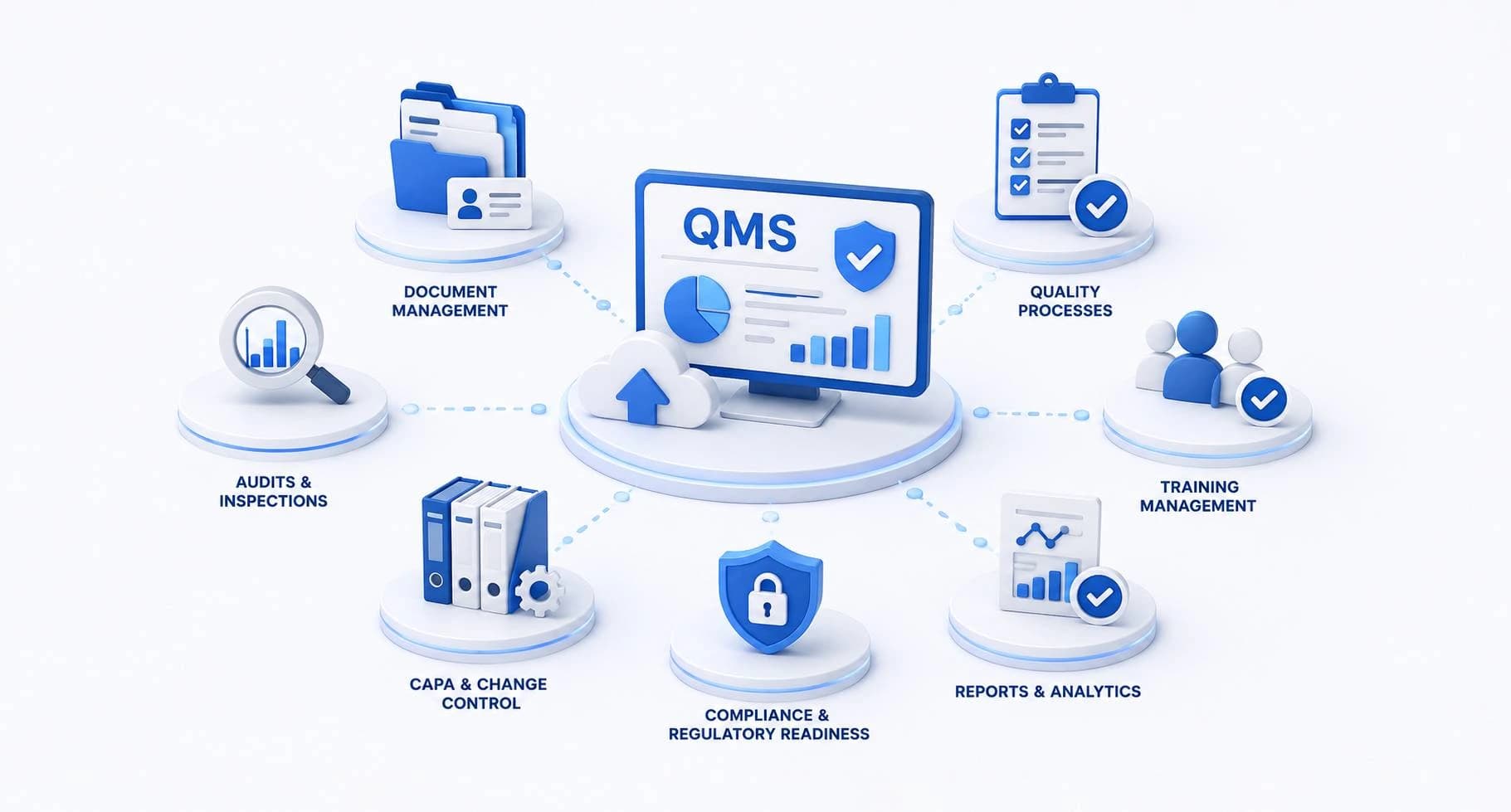
For decades, quality management in the life sciences industry was built around paper records, spreadsheets, email chains, and disconnected systems. While these approaches may have worked when organizations were smaller, they have become increasingly difficult to manage in today's regulatory environment.
Evolving FDA Standards
Exploding Data Volumes
Rigorous Audits
Complex Global Scope
As a result, many life sciences organizations are replacing manual quality processes with digital Quality Management System software, commonly known as Digital QMS.
The shift is not simply about reducing paperwork. It is about creating a quality system that is more controlled, more efficient, more transparent, and more capable of supporting compliance at scale. Organizations that successfully implement digital quality systems discover measurable improvements across operational efficiency, quality performance, inspection readiness, and decision making.
Paradigm Shift: Manual vs. Digital Systems
| Quality Vector | Legacy / Manual Approaches | Modern Digital QMS Platform |
|---|---|---|
| Visibility | Fragmented records across departments and isolated physical repositories. | Centralized single source of truth with cross-functional oversight. |
| Document Control | Manual version tracking, vulnerable approval chains, signature latency. | Automated lifecycle states, explicit electronic signatures, instant recall. |
| Audit Readiness | High-stress, retroactive tracking exercises taking weeks of discovery. | Continuous operational readiness with real-time verifiable audit trails. |
Compliance Depends on Visibility
One of the biggest challenges in any regulated environment is maintaining visibility across multiple distinct operational parameters.
- Deviations & CAPA Links
- Supplier Qualifications
- Cross-department approvals
Fragmented data architectures inherently multiply systemic compliance risks.
Control Over Documents
Documentation remains one of the most heavily scrutinized fields during rigorous regulatory inspections.
Digital QMS automates version control, approval workflows, and secure document management from one centralized platform.
Better Data Integrity and Traceability
The FDA expects data assets to strictly match standard lifecycle expectations: attributable, legible, contemporaneous, original, accurate, complete, consistent, and enduring throughout execution states.
Controlled digital platforms eliminate transcription vulnerability through integrated audit trails, explicit system access permissions, and automated record retention protocols.
Agile CAPA Management
Manual tracking frequently yields delayed investigation responses and poor accountability loops. Digital platforms drive proactivity through automated alerts, system escalation routing mechanisms, and multi-tier event linking.
Compliant Workforce Training
Manually coordinating training maps across spreadsheets quickly fails during scaling periods. A unified system automatically distributes modules based on specific job-role matrices, guaranteeing compliance transparency during field inspections.
Enhanced Audit and Inspection Readiness
Instead of spending critical weeks frantically pooling assets before an inspector arrives, a modern digital workspace anchors your operations into a permanent status of defense. Documents, verification signatures, historical logs, and change paths stay indexed, secure, and ready for instant query execution.
This continuous access profile aligns perfectly with the FDA's updated Quality Management System Regulation (QMSR), focusing on structural document transparency.
Better Decision Making Through Quality Data
Transform raw transactional information into actionable insights. Real-time reporting frameworks allow leadership to monitor trend patterns across operational deviations, supplier tracking vectors, and CAPA resolution velocities to substitute assumptions with clear evidence.
Quality and Compliance Are No Longer Separate Goals
Historically, compliance focused strictly on checking basic boxes to pass inspections, while actual quality focused independently on optimizing process outputs. Modern software structures consolidate these forces into a singular goal.
"Quality is not manufactured during an inspection; it is built into the everyday process."
Platforms like Zentixs Docs, Zentixs Track, and the integrated Zentixs Suite provide life sciences teams with the exact cross-linked tools required to turn compliance from a stressful periodic milestone into a clean, everyday standard of operations.
Ready to Transition to a Connected Digital QMS?
Connect with the Adrta advisory team today to evaluate how the unified Zentixs Platform can amplify structural clarity, trace visibility, and compliance health across your enterprise ecosystem.